
By Adam Bartley, COO Chrysalis | Connect on LinkedIn
Cell and gene therapy (CGT) manufacturing planning starts with a number, and that number is almost always wrong.
Facility investments, manufacturing capacity models, equipment purchases, workforce plans: they all trace back to an assumption about how many patients will need a therapy in year one, year three, and year five. Those patient counts shift constantly. Indications expand. Trials read out differently than planned. Regulatory pathways change under you, and real-world uptake almost never matches the pre-launch forecast. Meanwhile, the facility decisions have to be made years before any of that resolves.
That gap between when you have to build and when you actually know what you need is the hard part of planning cell and gene therapy manufacturing today. Over-build and you burn capital that should have gone into the science. Under-build and you hit a ceiling right when demand shows up. Neither is easily fixable after the fact, and most of the standard approaches to the problem end up making it worse.
Why CGT patient counts are so hard to predict
With small molecules and traditional biologics, patient populations are usually easier to size. Once a therapy is approved for a defined indication, the addressable market is generally understood, so manufacturing capacity can be planned around that number with a fair amount of confidence.
CGT programs behave differently. A cell therapy approved for one rare hematologic malignancy can end up serving three or four related indications within a few years. Pediatric gene therapies expand into adult populations. Allogeneic platforms pivot to different disease targets based on early clinical readouts. Every one of those shifts changes the patient count assumption in ways that make the original facility plan look either wildly overbuilt or badly undersized.
Modality choice piles on more uncertainty. Autologous therapies are patient-specific by design, so capacity is measured in slot count and turnaround time rather than batches per year. Allogeneic therapies may allow batch-based manufacturing but need larger capacity for viral vector or cell bank production. Companies pursuing hybrid strategies need both, and the ratio shifts as their programs mature.
And even after approval, real-world adoption for CGT products often diverges from pre-launch forecasts. Access and reimbursement dynamics, physician training, patient identification, manufacturing turnaround times: all of it shapes actual demand in ways the model did not fully capture. A product that looked like a 200-patient-per-year program during Phase III might see 400 patients in year two. Or 80.
The cost of guessing wrong
Facility decisions in CGT manufacturing are expensive and slow to reverse. A dedicated commercial facility can require $100 million or more in capital investment and 24 to 36 months of construction before first batch. Once it exists, its capacity is largely fixed. Adding capacity means adding cleanroom suites, which means another round of construction, qualification, and validation cycles that can stretch a year or more.
The problem cuts both ways. Over-building creates carrying costs that compound fast. A facility designed for 500 patients per year running at 150 patients still pays the full bill for HVAC, environmental monitoring, quality systems, and personnel. That gap becomes a permanent drag on program economics that is very hard to defend to investors or a board.
Under-building is worse. A CGT company that hits its capacity ceiling during launch has to make ugly choices: turn patients away, stretch manufacturing lead times, or scramble to add capacity while demand is already active. Adding capacity under pressure costs meaningfully more than adding it as part of a planned expansion, and it usually shows up in the launch numbers before it shows up in the facility.
There is a strategic cost hiding in this too. Companies locked into a specific facility size and configuration have a hard time pivoting when priorities shift. When clinical data changes the therapeutic focus, or a partnership deal shifts commercial responsibilities, the facility is usually the least flexible piece of the manufacturing strategy.
How companies traditionally handle uncertainty
Most CGT capacity planning falls into one of three patterns. All three have problems.
The most common is forecast-based planning. Companies build detailed patient count models, apply confidence intervals, and design a facility to serve the base case with some buffer for upside. This is standard practice, but the forecasts it relies on are not reliable for CGT programs. The buffer is usually too small to matter when the program grows and too expensive to justify when it does not.
The second is phased construction. Companies plan a facility that can grow over time, with additional cleanroom suites, equipment lines, or bioreactor capacity added as demand justifies. It reduces upfront risk but does not eliminate it. Phased expansion still needs long lead times, and the first phase still commits you to a specific facility footprint that may or may not fit where the program actually goes.
The third is full outsourcing to a CDMO. It looks like the CDMO absorbs the capacity question, but the same uncertainty is still there. You choose your CDMO using the same assumptions about volume, timing, and modality mix you would use to size your own facility. The difference is that you do not control their capacity utilization. If your program grows faster or slower than the slot they reserved, that becomes their scheduling problem across every other client on their books.
Larger CDMO networks position this scale as a strength, pitching their multi-site footprint as a way to grow with you. In practice, that transfer is not the seamless handoff it sounds like. Each facility may operate its own quality management system, its own batch records, and its own equipment qualifications. Moving your process from one location to another is a full tech transfer, not a phone call. That means comparability studies, revised documentation, and an IND update for the new site, all of which takes months. You end up back at the same capacity question you thought you had outsourced, now with a tech transfer added on top.
Designing for optionality
A better way to think about this is to stop trying to predict the patient count precisely, and instead build a manufacturing strategy that keeps options open.
What does that actually look like? It means starting with less committed capacity than the base case forecast suggests, then adding capacity as the program clarifies. It means treating infrastructure decisions as reversible for as long as you can, so that a shift in indication or commercial strategy does not strand capital or blow up your timeline. And it means picking a manufacturing model that supports incremental growth rather than one that locks you into a full facility footprint on day one.
That kind of model changes the sequence of what you commit to. You access cleanroom capacity at the level your current program needs, and expand from there. You bring in operational expertise at the scale that fits your stage, rather than hiring a full manufacturing organization before you have a first patient. And you qualify equipment against the process you are actually running, not the one you might run three years from now.
This approach also protects the downside case. If a program slows or pivots, you have not committed to infrastructure that no longer fits. If it accelerates, you have a defined path to add capacity through a partner who has already validated the environment. Either way you keep more of the decision surface than a fixed facility gives you.
How cleanroom hosting fits this problem
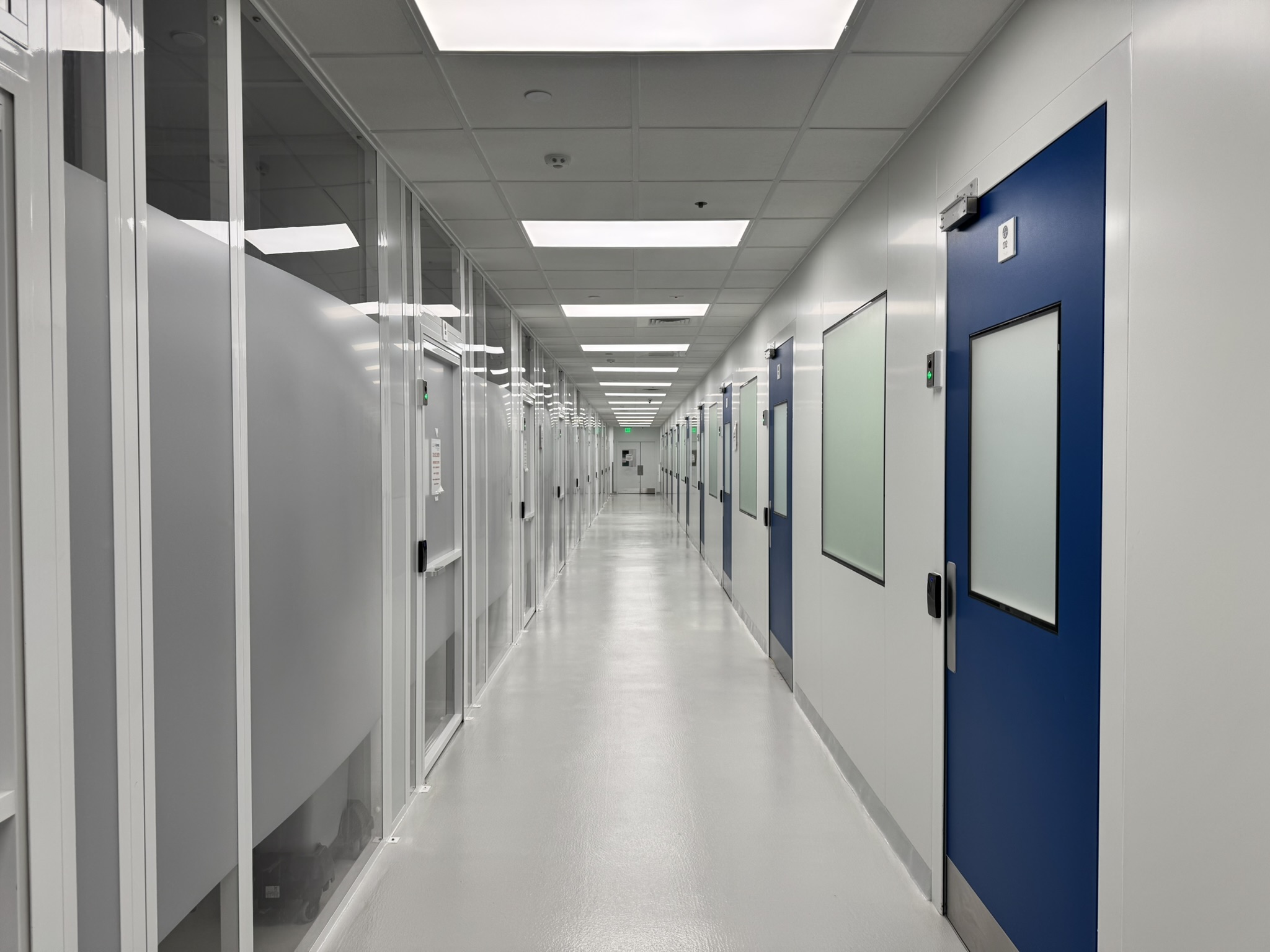
Cleanroom hosting is one of the few models built around this idea of optionality. Under a this arrangement, the sponsor gets dedicated GMP cleanroom space, established quality systems, environmental monitoring, and operational expertise from a partner, while keeping full ownership of product, process, and regulatory strategy. Capacity scales as the program matures rather than being committed upfront.
For CGT programs, that has a few specific advantages. The capital commitment to start GMP manufacturing is much lower, so companies can produce clinical material without pre-committing to a facility scaled for commercial demand that might not materialize. The timeline to first patient is shorter, which means more time to see actual clinical data before making a facility call. And the ability to change direction is preserved, whether the patient count moves up, moves down, or lands somewhere adjacent to what you expected.
The Chrysalis Platform is set up to support CGT programs through this kind of staged path. Chrysalis PILOT covers process development and preclinical readiness. Chrysalis ONE gives emerging companies GMP infrastructure for IND enabling and early clinical manufacturing. Chrysalis ADVANCE handles commercial-scale infrastructure for late-stage and validation work. Chrysalis LAUNCH supports commercial execution once programs reach the market. Companies can enter the platform at any stage, and the deliverables from each program carry forward as their needs change.
Planning for a moving target
The uncertainty around CGT patient counts is not going away. The modality keeps expanding, the indications keep getting more complex, and the regulatory and clinical environment keeps moving. Better forecasting is not going to fix this. The math is what it is.
Companies that keep treating patient count uncertainty as a forecasting problem will keep making expensive facility bets on numbers that turn out to be wrong. Companies that treat it as a permanent feature of CGT development, and build their manufacturing strategy to match, have a much better shot at ending up with capacity that actually fits what happens.
Designing for the unknown is not about being smarter than the forecast. It is about not needing to be. Cleanroom hosting is one of the few manufacturing models that lets you plan that way.
Make it yours
Choose your equipment, choose your layout, choose your services. Make yourself at home in a space designed for you.