

A follow-up to Accelerating Biotech Breakthroughs: A CFO’s Perspective on AI and Flexible GMP Infrastructure, focused on the financial tradeoffs between building internal GMP capacity and using Chrysalis’ GxP platform solution.
By James Kalinovich, CFO Chrysalis | Connect on LinkedIn
The Romance of the Build
In biotech, the instinct to build is easy to understand. A dedicated facility signals commitment, creates a sense of control, and can look like a rational long-term choice on a static spreadsheet. For boards and investors, internal manufacturing can even feel like a milestone that signals readiness to scale.
However, when considering clinical development success criteria, timeline risks and pre-approval facility utilization, building internal manufacturing capacity can cost materially more than a flexible GMP platform model, often by $10 to 13 million per program.
From a CFO’s perspective, the question is not whether manufacturing matters. It is whether fixed infrastructure is the most efficient way to advance a program whose timeline, capital needs, and ultimate success remain highly uncertain.
When Does Building Make Sense?
Before examining why flexible infrastructure often wins, it’s worth establishing when building actually makes sense. There are three relatively narrow scenarios:
- Multi-program platform companies with 4+ clinical-stage assets running concurrently, where the facility is utilized 80%+ of the time
- Late commercial stage (5+ years post-approval) with predictable, high-volume demand
- Strategic process-containment situations where a company determines that even platform-enabled external operations do not provide the level of control it requires
For most early-stage biopharma companies, these conditions don’t apply. Even companies with existing facilities may find that certain assets don’t fit their current setup. If your situation doesn’t fit these three scenarios, the economics of flexible infrastructure deserve serious consideration.
The Core Insight: You’re Paying for Idle Time
To make the economics tangible, consider one illustrative example: a cell therapy manufacturing facility. A facility like this can cost several million dollars per year to run, whether or not it is actively producing product. Staff, utilities, QC infrastructure, GMP audits, environmental monitoring, and contingency reserves do not pause when a program is between manufacturing campaigns.
The broader point extends well beyond this example: much of drug development consists of waiting between milestones, while fixed infrastructure continues to generate cost.
In practice, the path from Phase I to BLA submission can span roughly 8 to 15 years. A significant portion of that timeline (often 5 to 7 years) consists of inter-phase gaps where no manufacturing is taking place: clinical trial execution, data analysis, FDA meetings, protocol development, trial design and refinement, scale-up validation, dossier preparation. If you own the facility, that translates into tens of millions of dollars in cost during periods when the program is not actively using the infrastructure – capital investors generally expect to be deployed toward advancing the science.
The Challenge: Uncertainty in Drug Development
Now, overlay the uncomfortable truth about drug development: timelines and outcomes are inherently uncertain. Regulatory feedback cycles, clinical enrollment variability, manufacturing scale-up challenges, competitive dynamics, and market adoption all introduce unpredictability into even the most carefully planned programs.
Most drugs fail. The attrition pattern across clinical phases is steep, and it materially changes the economics of any decision to build dedicated infrastructure early.
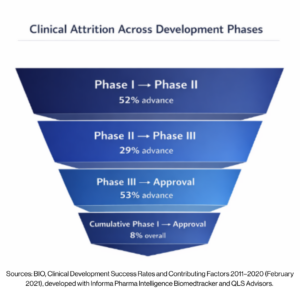
If you are entering Phase I, the probability of reaching approval remains low. Only about 8% of programs that enter Phase I ultimately gain approval. That reality matters financially: build too early, and you risk tying substantial capital to specialized infrastructure before the program has meaningfully de-risked.
But even programs that succeed face timeline uncertainty. Regulatory holds, unexpected clinical findings, manufacturing challenges, and shifting market conditions all mean that fixed infrastructure continues to generate costs during periods you can’t fully control or predict.
With a flexible operating platform model such as Chrysalis, companies can unlock access to GMP-ready capacity as programs advance, rather than carrying the cost and operating burden of a dedicated facility from the outset. That makes the downside of failure easier to contain, the capital allocation easier to defend, and the ability to adapt to changing timelines far more practical.
The Numbers, Across Every Decision Point
We modeled three timing scenarios: build at Phase I, build at Phase II, or wait until Phase III, when a larger share of scientific risk has been worked down. Across all three scenarios, the Chrysalis platform model remains the lower-cost path.
Much of the cost advantage early on comes from the fact that high failure rates make large upfront capital commitments harder to justify. Avoiding facility CapEx with limited residual value materially improves the economics of a flexible model.
Counterintuitively, the advantage often widens as programs advance. By Phase III, the probability of approval is materially higher, yet flexible infrastructure still retains an economic edge because capacity scales with need rather than carrying a full operating burden across long commercial horizons.
There is also an operational resilience dimension that pure cost modeling can miss. A single large site is a single point of failure. A regulatory hold, a facility event, or a supply disruption at that one location can stall the entire program. Chrysalis operates across multiple facilities, and tech transfer within the Chrysalis infrastructure is significantly less expensive than transferring between unrelated sites. That combination reduces both operational risk and the cost of adapting if a program needs to shift capacity between locations.
The analysis becomes misleading if uncertainty and attrition risk are ignored and the comparison is reduced to a single long-term cost scenario. In practice, capital allocation decisions need to reflect the probability of program changes and cancellation at each stage of development. Capital should be strategically deployed to flex with program evolution through development to commercialization. When uncertainty around timelines, market adoption, and manufacturing challenges is high, the probability of success should directly inform how capital is allocated.
Why the Chrysalis Platform Changes the Economics
This is where flexible GMP infrastructure changes the equation. The Chrysalis operating platform gives biopharma companies access to GMP-ready space, operational support, a Quality Management System (QMS), IP control, and flexible execution of their process without forcing them to carry the full cost of a dedicated facility through the ebb and flow of product development. Importantly, Chrysalis is an infrastructure and operating solution, not a product-development counterparty with visibility into the therapy IP itself. Companies benefit from Chrysalis’ deep expertise in operating and maintaining compliant, audit-ready GMP infrastructure, along with an established QMS history.
Capacity aligns more closely with active manufacturing needs. Access to GMP-ready infrastructure is maintained without the full fixed-cost burden. The idle-time burden is reduced between development phases, and companies retain control of their intellectual property while leveraging quality systems expertise.
By contrast, owning the facility means carrying fixed operating costs that continue whether manufacturing is active or not, committing upfront capital before the program is meaningfully de-risked, and accepting buildout time that can delay clinical start and push downstream milestones further out.
The Chrysalis platform advances the same manufacturing objective while avoiding the cost of underutilized infrastructure.
The “But What If We Succeed?” Counter-Argument
Every biopharma leader asks the same question: “Sure, but if our drug succeeds, doesn’t owning the facility eventually pay off?”
The answer is no. Even after commercial approval, which is the more favorable outcome for the build case, the flexible GMP operating platform still compares more favorably on long-term cost.
Even with commercial approval, the economics favor flexible infrastructure. The reason is straightforward: the cost of owning and operating a dedicated facility continues across development pauses and into long-term commercial operations, whereas a flexible model lets capacity scale more closely with actual need.
The Strategic Capital Question
For a Series B biotech with $80–120M in the bank, an $8M facility build is not just an operating choice, it’s a capital-allocation decision. Investors generally reward progress at the milestones that reduce scientific and commercial uncertainty most: clinical data, regulatory advancement, and evidence that a program can move toward Phase II and beyond. On that basis, fixed infrastructure is usually a lower-return use of capital than activities that directly de-risk the asset.
That logic matters even earlier for Series A investors. Every dollar not tied up in facility CapEx lowers the amount of capital a company needs to raise before reaching meaningful inflection points. In practice, that can reduce dilution, preserve more ownership for early backers, and increase the odds that the next round is raised on stronger clinical evidence rather than to finance infrastructure. Put differently, the same capital can often be redirected into the kinds of milestones and options that investors value far more highly:
- Extend Phase II operations by 12–18 months
- Fund a second indication
- Accelerate regulatory execution
Those examples illustrate the real opportunity cost of building. Capital that extends runway, supports additional indications, or accelerates regulatory execution is far more likely to improve company value than owning a specialized facility. A buildout may increase fixed cost and operational complexity, but it rarely changes the milestones that drive financing, partnering, or exit outcomes.
There is also a practical risk question behind the capital question. Chrysalis’ expertise is operating and maintaining compliant, audit-ready GMP infrastructure and operations at the facility level. In contrast, for a startup, building and operating that infrastructure is a new capability layered on top of an already high-risk undertaking. In that context, taking on infrastructure execution risk in-house is often an unnecessary bet, especially when the company’s real value lies in advancing the science, not in becoming expert at facility operations.
Conclusion
The disciplined choice is usually the same: preserve flexibility, avoid unnecessary fixed-cost burden, and allocate capital to the scientific and regulatory milestones that will determine the company’s outcome.
Make it yours
Choose your equipment, choose your layout, choose your services. Make yourself at home in a space designed for you.